How to Keep a 14K Gold Anklet Looking Beautiful Over Time

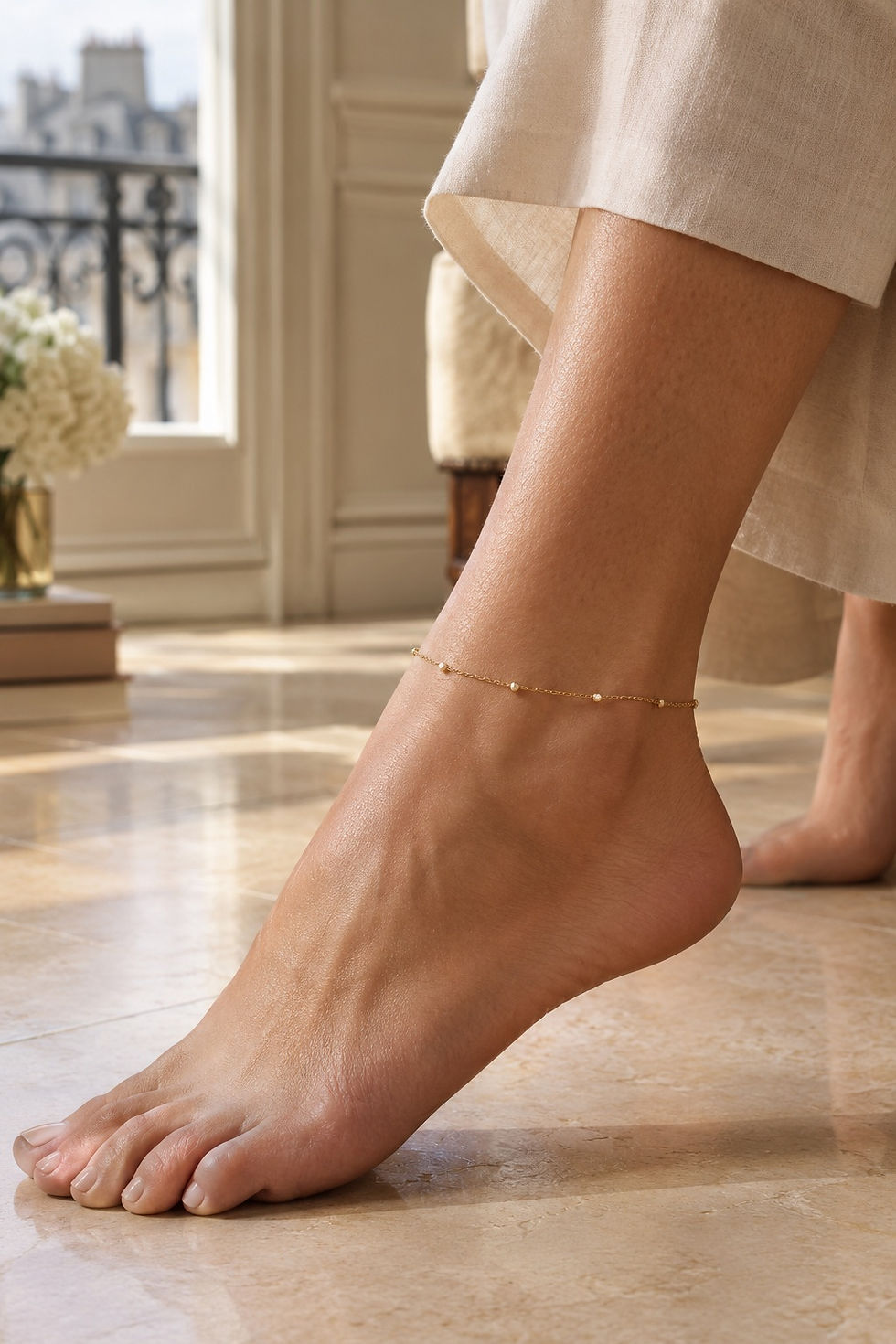
There is something particularly effortless about a delicate gold anklet.
It may be one of the smallest pieces in a jewellery collection, but when the proportions are right, it can change the way an entire outfit feels. A fine chain peeking beneath tailored trousers. A subtle glint above a pair of sandals. A barely-there detail against bare skin.
That understated quality is exactly what makes a 14K gold anklet worth caring for properly.
Unlike jewellery that is designed to make a dramatic statement, minimalist pieces depend on their finish, proportion and condition. A delicate chain does not need excessive sparkle to look beautiful. It needs to remain clean, well-maintained and structurally sound.
And because an anklet sits close to the ground, it encounters a different kind of daily wear from a necklace or pair of earrings.
It may meet footwear, dust, perspiration, fabric, skincare products, water and the occasional accidental tug.
So how do you keep a 14K gold anklet looking beautiful over time?
The answer isn't complicated.
Good care is less about constantly polishing your jewellery and more about reducing unnecessary exposure, storing it correctly, cleaning it gently and paying attention to the construction of the piece.
Let's look at what actually matters.
Why Does a 14K Gold Anklet Need Care?
14K gold is made from gold combined with other metals to create an alloy with characteristics suitable for jewellery.
That composition makes 14K gold practical for regular jewellery use, but it does not make the finished piece immune to wear.
An anklet can be particularly exposed because of where it sits on the body.
Throughout the day, it may encounter:
Sand and dust
Shoes and sandals
Clothing and hems
Sweat and perspiration
Body lotion
Sunscreen
Perfume
Soap
Water
Bedding
Furniture
Accidental pulling or snagging
Over time, these factors can leave residue on the surface of the jewellery or contribute to mechanical wear.
There is also an important distinction between the material and the jewellery itself.
A 14K gold alloy may be durable, but a very fine chain, small clasp or delicate connecting ring can still be vulnerable to excessive pulling.
This is why caring for luxury minimalist jewelry is not simply about keeping the gold shiny.
It is about preserving the entire piece.
1. Start With the Material
Before deciding how to care for an anklet, understand what you actually own.
A piece described as “gold” can refer to several different constructions.
For example, jewellery may be:
Solid 14K gold
Solid 18K gold
Gold-filled
Gold-plated
Gold vermeil
Gold-tone jewellery
These materials should not be treated as though they have identical properties.
If your anklet is made from genuine 14K gold, the gold itself is incorporated into the alloy rather than being simply a surface coating over another base material.
That distinction matters when considering longevity.
With plated jewellery, the visible gold layer can gradually wear depending on the thickness of the plating, construction and conditions of use.
With solid gold jewellery, care is still important, but you are maintaining a gold alloy rather than trying to preserve a thin external coating.
The first rule of jewellery care is therefore simple: know the material before choosing the maintenance routine.
2. Everyday Wear Does Not Have to Mean Constant Wear
One of the easiest ways to preserve a delicate anklet is also one of the most overlooked:
You don't have to wear it every minute of the day.
A beautiful piece can be part of your everyday wardrobe without being treated as something that never needs to come off.
Consider removing your anklet before activities where it is likely to experience unnecessary friction, chemicals or physical stress.
This includes:
Swimming
Hot tubs
Intense workouts
Beach activities
Gardening
Activities involving sand or dirt
Showering with strong soaps or exfoliating products
This does not mean that a 14K gold anklet becomes unusable around water.
Rather, removing it when exposure is unnecessary can reduce the accumulation of residue and minimise avoidable wear on the chain, clasp and other components.
Think of it as wardrobe rotation rather than restriction.
Your jewellery should fit naturally into your life, but not every activity needs to involve jewellery.
3. Be Careful With Skincare and Fragrance
A surprisingly large amount of residue on jewellery comes from products we put on our skin every day.
Moisturisers, body oils, sunscreen, perfume and other cosmetic products can settle around a delicate chain.
Over time, that residue can make a piece appear less bright or leave a film on its surface.
A simple routine can help.
Apply your skincare and fragrance first.
Give products a little time to absorb or dry.
Then put on your anklet.
This small change can reduce the amount of product that comes directly into contact with the jewellery.
The same principle applies when getting ready for a special occasion.
Instead of spraying perfume directly over jewellery, apply fragrance to the skin before putting your pieces on.
It is a small detail, but luxury often lives in these small details.
4. Keep the Anklet Clean - But Keep the Cleaning Gentle
A 14K gold anklet does not need an elaborate cleaning ritual.
In fact, overly aggressive cleaning can create more problems than it solves.
For routine maintenance, begin with:
Lukewarm water
A small amount of mild soap
A very soft jewellery brush or soft cloth
A clean, lint-free towel
Gently clean the surface and around the links.
Do not scrub aggressively, particularly if the chain is very fine.
Once clean, rinse it carefully and pat it dry.
Allow the anklet to dry completely before putting it away.
The objective is not to make the jewellery look artificially brilliant.
It is simply to remove everyday residue while preserving the natural finish of the metal.
What should you avoid?
Be cautious with:
Abrasive cleaners
Rough brushes
Household cleaning chemicals
Bleach
Strong polishing compounds
Excessive rubbing
If the anklet includes gemstones, pearls, enamel or other delicate materials, the appropriate cleaning method may be different.
When in doubt, follow the manufacturer's care instructions or ask a qualified jeweller.
5. Pay Attention to the Chain

When people think about jewellery care, they often focus on the visible surface of the gold.
For an anklet, the chain deserves just as much attention.
A delicate chain can experience repeated movement every time you walk.
The areas worth checking occasionally include:
Clasp
Jump rings
Connecting points
Extension chain
Individual links
Charms or pendants
Soldered areas
Look for anything that seems unusually loose, bent or distorted.
If a clasp starts feeling different or a link appears stretched, don't wait for it to break.
A jeweller may be able to repair or reinforce the component before the problem becomes more significant.
This is particularly relevant to luxury minimalist jewelry because its beauty often depends on fine proportions.
A tiny structural issue can affect the way the entire piece sits on the ankle.
6. Avoid Sleeping in a Very Delicate Anklet
Sleeping in jewellery can feel harmless.
After all, you're not actively using your feet while you're asleep.
But movement during the night can still create friction between jewellery, bedding and skin.
A fine anklet can also become caught in fabric.
If the design is especially delicate, removing it before bed can be a sensible way to reduce unnecessary mechanical stress.
It also gives you an opportunity to inspect the piece before storing it.
For jewellery intended for long-term use, these small periods of rest can be beneficial.
7. Store Your Anklet Properly
How you store jewellery matters almost as much as how you clean it.
A delicate anklet should ideally have its own space.
Avoid throwing it into a jewellery box with several other chains.
Why?
Because chains can tangle, links can catch on other pieces and repeated friction can cause unnecessary wear.
A soft pouch or individual compartment works well.
For a minimalist jewellery collection, organisation also makes it easier to notice changes in a piece.
If the chain suddenly looks twisted or the clasp isn't closing as it normally does, you'll spot it sooner.
A simple storage routine
Before storing your anklet:
Wipe away visible residue with a soft cloth.
Make sure the piece is completely dry.
Close the clasp where practical.
Place it in an individual pouch or compartment.
Keep it away from excessive humidity and unnecessary friction.
A little organisation can go a surprisingly long way.
8. Don't Confuse Natural Wear With Damage
Gold jewellery is not supposed to remain perfectly untouched forever.
A piece that is worn regularly will naturally develop tiny signs of use.
That is different from significant damage.
A few subtle changes in surface appearance are part of a jewellery piece's life.
However, certain signs deserve attention.
Consider having your anklet inspected if you notice:
A loose clasp
A visibly stretched link
A bent component
A broken or partially open connecting ring
A charm that no longer sits correctly
A chain that repeatedly catches on clothing
A sudden change in how the piece fits
The earlier a structural issue is addressed, the easier it may be to prevent further damage.
This is particularly important with delicate anklets because a small weak point can eventually result in the chain separating.
9. Proportion Matters More Than You Might Think
Care begins before you even purchase the anklet.
The right piece for you should suit both your wardrobe and your lifestyle.
If you lead an active lifestyle, an extremely fine chain may require more attention than a slightly more substantial design.
If your wardrobe leans toward tailored trousers, silk dresses and understated sandals, a fine anklet may complement the proportions beautifully.
This is where luxury minimalist jewelry differs from jewellery chosen purely for visual impact.
The objective isn't necessarily to select the largest, brightest or most elaborate piece.
It is to find something whose scale, finish and construction make sense together.
A well-proportioned anklet can be almost invisible from a distance and still feel intentional when noticed.
That restraint is part of its appeal.
10. 14K Gold vs Other Gold Finishes: Does Care Change?

Yes.
The care routine should reflect the material.
Jewellery type | General care consideration |
14K solid gold | Focus on gentle cleaning, storage and protecting the chain |
18K solid gold | Similar gentle care; higher gold content does not eliminate the need for maintenance |
Gold-filled | Avoid unnecessary chemical exposure and abrasive cleaning |
Gold-plated | Take extra care to minimise friction and conditions that may wear the surface |
Gold vermeil | Gentle handling is particularly important because the gold layer sits over sterling silver |
This is why shopping by appearance alone can be misleading.
Two anklets may look almost identical when new while having very different material constructions.
When choosing a piece, read the product specifications carefully.
Material, construction, finish and intended use all contribute to the ownership experience.
How Often Should You Clean a 14K Gold Anklet?
There isn't one universal schedule.
The right frequency depends on how often you wear the piece and what it is exposed to.
If you wear your anklet frequently, a gentle wipe with a soft cloth can be part of your normal jewellery routine.
A more thorough gentle cleaning can be done when you notice:
Product residue
Dullness
Visible dirt
Perspiration buildup
A change in surface appearance
You don't need to clean jewellery simply for the sake of cleaning it.
Overhandling a delicate chain can itself create unnecessary stress.
Clean when it needs cleaning, and handle it with intention.
Can a 14K Gold Anklet Stay Beautiful for Years?
With appropriate care, genuine gold jewellery can remain part of a jewellery collection for a very long time.
But longevity isn't determined by gold purity alone.
It comes from several factors working together:
Material + construction + proportion + maintenance + wear habits.
A well-made 14K gold anklet that is stored carefully, cleaned gently and protected from unnecessary stress can remain a beautiful everyday piece.
And there is something appealing about that idea.
Minimalist jewellery does not need to be replaced every season.
The right piece can quietly become familiar.
It can accompany different wardrobes, different years and different versions of your personal style without demanding attention.
How to Keep Your 14K Gold Anklet Looking Beautiful: A Simple Routine
If you want the entire article condensed into a practical routine, keep these habits in mind:
Before wearing
Apply lotions and fragrance first.
Allow skincare products to settle.
Check that the clasp is secure.
During the day
Avoid unnecessary pulling or snagging.
Be mindful around shoes and rough surfaces.
Remove the anklet for strenuous activities when appropriate.
After wearing
Wipe away visible residue.
Allow the piece to dry completely.
Check the chain and clasp occasionally.
For storage
Keep it separate from other jewellery.
Use a soft pouch or individual compartment.
Avoid leaving delicate chains tangled together.
For cleaning
Use lukewarm water and mild soap when appropriate.
Handle the chain gently.
Avoid abrasive or harsh chemical cleaners.
It doesn't take much.
The key is consistency.
Choosing Luxury Minimalist Jewelry That Ages Well
Beautiful jewellery isn't only about how a piece looks when it arrives.
The more useful question is how well the design fits into real life.
When considering a delicate gold anklet or another piece of luxury minimalist jewelry, look beyond the photographs.
Consider:
What is the jewellery actually made from?
Is the material clearly disclosed?
Does the chain construction suit your lifestyle?
Is the clasp practical?
Are the proportions comfortable?
Does the finish suit your wardrobe?
Are the care instructions clear?
Can the piece be worn in different settings?
These questions help move the decision beyond aesthetics.
Because a beautiful piece that doesn't suit your lifestyle may spend more time in a jewellery box than on you.
The best minimalist pieces tend to be the ones that feel natural to wear.
The Bottom Line
Keeping a 14K gold anklet beautiful over time doesn't require complicated maintenance.
It comes down to thoughtful everyday habits.
Protect it from unnecessary chemicals and excessive friction. Remove it for activities where it could be pulled, scratched or exposed to harsh conditions. Clean it gently when needed. Store it separately. And pay attention to the small components that hold the piece together.
Most importantly, remember that 14K gold is only one part of the equation.
The material matters.
So do proportion, construction, finish, craftsmanship and the way the jewellery is worn.
That is especially true when choosing luxury minimalist jewelry, where there is nowhere for poor proportions or careless construction to hide.
A delicate anklet does not need to shout to be noticed.
Sometimes, the most beautiful pieces are the ones that simply remain beautiful.
Frequently Asked Questions About Caring for a 14K Gold Anklet
How do I keep a 14K gold anklet shiny?
Clean it gently when necessary using lukewarm water, mild soap and a soft cloth or brush. Avoid abrasive cleaners and excessive polishing.
Can I wear my 14K gold anklet every day?
A 14K gold anklet can be suitable for regular wear, but everyday wear doesn't have to mean wearing it through every activity. Removing it before swimming, intense exercise or situations involving excessive friction can help reduce unnecessary wear.
Should I remove my gold anklet before showering?
Removing jewellery before showering is a simple precaution, particularly when soaps, exfoliants or other cosmetic products are involved. It can help reduce residue and unnecessary exposure over time.
Can sweat damage a 14K gold anklet?
Sweat and perspiration can leave residue on jewellery. Regular gentle cleaning and allowing the piece to dry can help maintain its appearance.
How should I store a delicate gold anklet?
Store it separately in a soft pouch or individual jewellery compartment. Keeping chains apart helps reduce tangling, friction and accidental pulling.
Does 14K gold need to be polished?
Not necessarily. Routine gentle cleaning is often sufficient. Excessive polishing can be unnecessary, particularly for delicate jewellery.
How can I tell if my anklet needs professional repair?
Look for loose clasps, stretched links, bent components, damaged connecting rings or changes in how the anklet sits. A jeweller can inspect the piece before a small issue becomes a larger one.
Is 14K gold suitable for minimalist jewellery?
Yes. Its balance of gold content and practical durability makes 14K gold a common choice for delicate jewellery designed for regular wear. The quality of the finished piece still depends on its construction and craftsmanship.


Comments