What Makes Luxury Minimalist Jewelry Look Expensive?


There is a particular kind of jewelry that does not need to announce itself.
No oversized logo.
No excessive sparkle.
No complicated styling.
Just a beautifully proportioned piece catching the light at exactly the right moment.
And somehow, it looks expensive.
That effect is often misunderstood.
Luxury minimalist jewelry is not simply about making jewellery smaller. A tiny piece can look ordinary just as easily as an elaborate one can look luxurious.
The difference usually comes down to how the piece is designed, made, finished and worn.
Think about a simple gold bracelet.
One version may feel disposable. Another may look as though it belongs in a Parisian jewellery salon.
Both might appear minimal at first glance.
So what creates the difference?
The answer is rarely one single feature. It is the relationship between material, proportion, surface, craftsmanship, restraint and styling.
And as fashion moves through 2026, that distinction is becoming increasingly interesting.
Current fashion coverage is showing a broader accessory conversation: pearls, brooches, charms and expressive pieces are appearing alongside polished wardrobe essentials, while Paris street style continues to demonstrate how minimalist accessories can coexist with texture, tailoring and stronger fashion statements.
The result is not the disappearance of minimalism.
It is an evolution of it.
Let's look at what actually makes minimalist jewelry look expensive.
1. It Starts With Proportion
Luxury often reveals itself through proportion before anything else.
A chain that is too thick can overwhelm a delicate wrist.
A pendant that is too small can disappear completely.
A ring that is too large for the finger can feel decorative rather than refined.
Expensive-looking jewelry tends to have a sense of visual balance.
The dimensions feel intentional.
The links relate to one another.
The pendant sits at an appropriate scale.
The setting does not overpower the stone.
Even the thickness of the band contributes to the overall impression.
This is one reason minimalist jewelry can be surprisingly difficult to design well.
There is nowhere to hide.
When a piece contains very little, every millimetre matters.
A small change in chain thickness or pendant proportion can completely change how the piece feels.
That is why refined jewelry often looks almost effortless.
The effort is simply built into the proportions.
2. The Material Has to Look Like the Material
Luxury minimalist jewelry does not try to disguise what it is made from.
Gold should look like gold.
Silver should look like silver.
A gemstone should retain its natural visual character rather than appearing artificially exaggerated.
This becomes particularly important in photographs.
Cheap-looking jewelry often relies on excessive shine to communicate value.
The surface becomes almost mirror-like.
The highlights become too bright.
The gold becomes unnaturally yellow.
The result may photograph as “sparkly,” but sparkle is not the same thing as luxury.
Fine-looking jewelry usually has controlled reflection.
You can see the metal.
You can see its surface.
You can see the way light moves across its curves.
That subtlety creates depth.
It is one of the reasons realistic metal finishing matters so much in both jewellery design and jewellery photography.
3. Gold Colour Matters More Than You Think
Not all gold looks the same.
The karat, alloy composition, finish and lighting can influence how a gold piece appears.
A rich yellow-gold surface may feel traditional and opulent.
A softer champagne tone can feel more understated.
White gold can create a cooler, architectural impression.
Rose gold introduces warmth and softness.
None of these is inherently more luxurious than another.
What matters is whether the colour works with the design language of the piece.
For minimalist jewelry, subtlety can be especially important.
If the colour is too intense, the metal can become the first thing you notice.
If the finish is too reflective, the design can lose its quiet character.
The goal is not necessarily to make the jewellery look brighter.
It is to make the material look beautifully resolved.
4. Surface Finish Creates Quiet Luxury
This is one of those details most people notice without consciously identifying.
Two pieces can have almost identical shapes.
One looks ordinary.
The other feels elevated.
Often, the difference is the surface.
Polished finishes create clean, controlled reflections.
Brushed or satin finishes diffuse light.
Hammered finishes introduce texture.
High-quality finishing allows edges, curves and surfaces to interact with light in a deliberate way.
This is particularly important in minimalist jewelry because there are fewer decorative elements competing for attention.
A simple ring with beautifully finished edges can feel more luxurious than a heavily embellished ring with poor finishing.
That is the paradox of minimalism:
The less there is, the more visible the details become.
5. Expensive-Looking Jewelry Has Better Visual Restraint
There is a difference between minimal and empty.
Minimalism does not mean removing every detail.
It means knowing which details deserve to remain.
A beautifully designed pendant might contain one distinctive curve.
A bracelet might use an unusual clasp.
An ear cuff might have a sculptural profile.
A ring might use an unexpected proportion.
The design remains restrained, but it still has a point of view.
That distinction is important.
Luxury minimalist jewelry should not look unfinished.
It should look edited.
Every visible element should have a reason to exist.
6. The Clasp Is Part of the Design
The clasp is one of the easiest details to overlook.
It is also one of the places where the quality of a piece can become apparent.
A poorly proportioned clasp can interrupt an otherwise elegant chain.
A bulky fastening mechanism can make a delicate bracelet feel visually unbalanced.
A well-designed clasp, by contrast, feels integrated.
Sometimes it is intentionally visible.
Sometimes it almost disappears.
Either way, it should feel appropriate to the scale and construction of the jewellery.
This is particularly relevant for everyday pieces.
Luxury is not only what people see.
It is also what they experience when they put the piece on, adjust it and wear it.
7. Fine Jewelry Does Not Need to Look Fragile
Minimalist does not necessarily mean ultra-thin.
This is another misconception worth leaving behind.
A beautifully proportioned piece can have presence without becoming oversized.
A slightly stronger chain can look more intentional.
A substantial cuff can remain elegant when its geometry is clean.
A signet ring can be bold while still feeling refined.
The key is visual weight.
Luxury design often plays with weight carefully.
Something can feel substantial without looking heavy.
That balance is especially relevant as current fashion moves between delicate styling and more expressive accessories. Fall 2026 accessory coverage, for example, includes everything from pearls and charms to brooches and statement pieces, suggesting that the conversation is less about strict minimalism versus maximalism and more about intentional accessorising.
Minimalism is becoming less about having nothing.
It is becoming more about knowing what deserves attention.
8. Jewelry Looks More Expensive When It Belongs to the Outfit
The most beautiful piece of jewelry can look misplaced if the styling works against it.
This is why luxury styling rarely treats accessories as isolated objects.
Consider a simple gold necklace with a crisp white shirt.
Or a sculptural cuff with a black evening dress.
Or a delicate bracelet with tailored trousers.
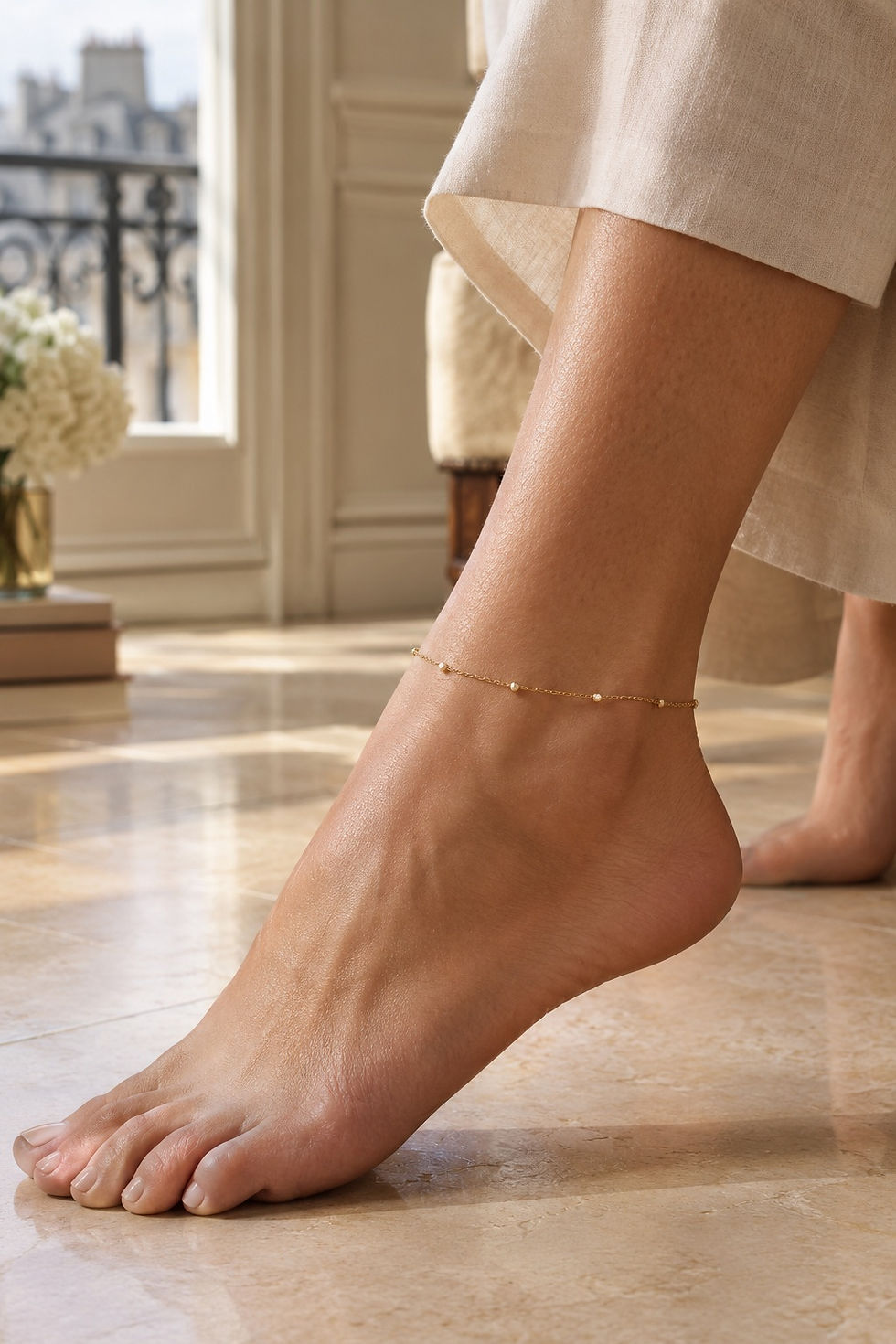
Or a fine anklet with understated sandals.
The jewellery does not need to dominate the outfit.
It becomes part of the visual architecture.
Paris street style has repeatedly demonstrated this relationship between elegant wardrobe essentials and restrained accessories, often allowing texture, tailoring or a single accessory to provide the visual emphasis.
That is an important lesson for minimalist jewelry:
The piece should complement the wearer, not compete with her.
9. Negative Space Makes Jewelry Feel More Luxurious
One of the simplest styling tricks is also one of the most effective:
Leave room.
A necklace does not always need another necklace beside it.
A ring does not always need to be stacked.
A bracelet does not need to share the wrist with five others.
Negative space gives jewelry somewhere to breathe.
It allows the eye to appreciate the shape of the piece.
This is especially effective with sculptural or finely detailed designs.
If every part of an outfit is demanding attention, nothing feels particularly special.
But when one beautiful detail is given space, it becomes noticeable.
That is where understated luxury begins to feel intentional rather than merely simple.
10. The Best Minimalist Pieces Have a Recognisable Design Language
Luxury houses are rarely built around random products.
There is usually a visual vocabulary.
Certain proportions repeat.
Certain shapes return.
Certain materials become signatures.
The pieces feel related even when they belong to different collections.
This is one reason a jewellery wardrobe can feel more sophisticated when its pieces share an underlying design language.
Perhaps that means:
Clean geometric lines
Soft organic curves
Sculptural silhouettes
Restrained gold tones
Architectural proportions
Understated gemstone placement
The goal is not for everything to match.
It is for everything to belong together.
That distinction creates a much more considered wardrobe.
11. Craftsmanship Is Visible Even When You Cannot Explain It

You do not necessarily need to know how a piece was made to recognise when something feels beautifully finished.
Edges appear cleaner.
Connections feel more intentional.
Stones sit naturally within their settings.
The surface catches light consistently.
The piece moves with the body instead of fighting against it.
These are small observations, but together they influence perception.
This is why the phrase “luxury minimalist jewelry” should never be reduced to aesthetics alone.
Luxury also involves the physical experience of the object.
How does it feel in your hand?
How does it move?
How does the clasp close?
How does the surface respond to light?
How does it sit against the skin?
Those questions matter.
12. A Little Personality Makes Minimalism More Memorable
Minimalism does not have to mean anonymous.
In fact, one distinctive detail can make a restrained piece far more memorable.
A curved silhouette.
An unusual drop.
A sculptural ear cuff.
A subtle charm.
A geometric link.
A gemstone positioned slightly differently.
This is particularly relevant now because fashion is moving toward more individual approaches to accessorising.
Recent Fall 2026 accessory reporting has highlighted charms, brooches, pearls and other personal-looking accessories alongside more traditional polished pieces.
The lesson is not to follow every accessory trend.
It is to understand why certain pieces attract attention.
Often, it is because they communicate personality without requiring explanation.
13. What Makes Jewelry Look Cheap?
It is useful to look at the other side of the equation.
Several details can immediately reduce the perceived value of minimalist jewelry.
These include:
Excessively bright or artificial-looking metal
Poorly proportioned chains
Bulky clasps on delicate pieces
Uneven finishing
Overly large logos
Excessive decorative elements
Artificial-looking gemstone settings
Poorly matched materials
Jewellery that looks disconnected from the outfit
Too many competing pieces worn together
None of these automatically makes a piece inexpensive.
But when several appear together, the jewellery can lose the visual restraint associated with luxury.
This is why “more expensive” and “more decorated” are not synonyms.
Sometimes the most expensive-looking detail is simply better proportion.
14. Does Minimalist Jewelry Have to Be Gold?
Not at all.
Gold has an established association with luxury, but the principle of expensive-looking minimalism extends well beyond gold.
Silver can look exceptionally sophisticated when its geometry and finish are carefully considered.
Platinum offers a naturally refined presence.
Pearls can create softness without excessive ornamentation.
Diamonds and other gemstones can introduce light while remaining restrained.
Even mixed-metal designs can feel elevated when the relationship between the materials is deliberate.
The important question is not:
“Is this material expensive?”
It is:
“Does the material, finish and design work together convincingly?”
That is a much more useful way to think about luxury.
15. The Future of Minimalist Jewelry Is Not Necessarily More Minimal
This may be the most interesting part of the conversation.
Minimalist jewelry is not disappearing.
But it is becoming more expressive.
The current fashion cycle is showing a willingness to combine polished essentials with more individual accessories. Paris street style has paired minimalist accessories with movement, tailoring and richer textures, while Fall 2026 accessory reporting points toward pearls, brooches, charms and other pieces that allow personal expression.
That suggests a subtle shift.
The future of luxury minimalism may not be about owning fewer decorative elements simply for the sake of simplicity.
It may be about choosing fewer, better-defined pieces.
A single sculptural cuff.
A beautifully proportioned chain.
An elegant ear cuff.
A discreet gemstone ring.
A delicate anklet that only reveals itself when you move.
The jewellery becomes part of your identity rather than simply another trend.
How to Make Your Jewelry Look More Expensive

You do not necessarily need an entirely new jewellery collection.
Start with what you already own.
1. Choose one focal piece
Let one piece lead the look.
2. Give it space
Avoid surrounding a beautiful piece with unnecessary competition.
3. Match proportions
Pair delicate jewellery with similarly refined clothing when you want an especially polished effect.
4. Pay attention to metal harmony
If you mix metals, make the contrast feel intentional.
5. Keep the rest of the styling quiet
Clean tailoring, simple silhouettes and beautiful fabrics allow jewellery to become more noticeable.
6. Prioritise condition
Clean jewellery looks different from jewellery covered in residue from lotion, perfume and everyday wear.
7. Choose pieces with longevity
The most convincing luxury pieces are rarely dependent on one microtrend.
They should still make sense when the trend cycle has moved on.
The SORIANÉ Perspective: Luxury Is in the Editing
There is a reason the most memorable jewellery is not always the jewellery that asks to be noticed first.
Sometimes it is the ring you notice when someone reaches for a glass.
The bracelet that catches the light beneath a tailored sleeve.
The tiny gold detail visible beneath a trouser hem.
The ear cuff that changes the profile of an otherwise simple look.
These moments feel luxurious because they are not forced.
They allow discovery.
And perhaps that is where modern minimalism is heading.
Not toward jewellery that says less for the sake of saying less, but toward jewellery that knows exactly what it wants to say.
Luxury is not necessarily a matter of adding more.
It can be a matter of choosing better.
Better proportions.
Better materials.
Better finishing.
Better styling.
Better restraint.
That is what makes a minimalist piece feel expensive.
Not because it is trying to look expensive.
Because every detail has been considered.
What Makes Luxury Minimalist Jewelry Look Expensive? The Bottom Line

Expensive-looking minimalist jewelry is rarely defined by one material, one gemstone or one price point.
It is the result of many quiet decisions working together.
Proportion. Material. Finish. Craftsmanship. Scale. Styling. Restraint.
The strongest pieces do not overwhelm the person wearing them.
They become part of her.
And that may be the most enduring definition of luxury:
Not being the loudest thing in the room, but being the detail someone remembers.
Frequently Asked Questions About Luxury Minimalist Jewelry
What makes minimalist jewelry look expensive?
Minimalist jewelry tends to look more luxurious when its proportions, materials, finish and construction are carefully considered. Refined styling and visual restraint can also make a significant difference.
Does expensive-looking jewelry have to be made of gold?
No. Gold is strongly associated with luxury, but silver, platinum, pearls and gemstones can also look highly refined when the design, finish and proportions are intentional.
Why does some gold jewelry look more luxurious than other gold jewelry?
Gold colour, karat, surface finish, construction, proportions and lighting all influence how a piece is perceived. A controlled, realistic finish can look more refined than an overly bright or yellow surface.
Is minimalist jewelry still fashionable in 2026?
Minimalist jewellery remains relevant, but current fashion is also embracing more individual accessories, including pearls, brooches, charms and expressive statement pieces. The broader direction is toward intentional styling rather than one strict definition of minimalism.
How can I make my jewelry look more expensive?
Choose well-proportioned pieces, keep them clean, give individual pieces visual space and style them with clothing that complements rather than competes with the jewellery.
Can statement jewelry still look luxurious?
Absolutely. Luxury does not require jewellery to be delicate. A statement piece can feel sophisticated when its proportions, materials, construction and styling are controlled.
What is quiet luxury jewelry?
Quiet luxury jewellery generally refers to pieces that communicate refinement through material quality, craftsmanship, proportion and restraint rather than obvious logos or excessive decoration.
Should minimalist jewelry be worn alone?
Not necessarily. Minimalist pieces can be worn individually or layered. The important consideration is balance. Layering should create a deliberate composition rather than visual clutter.


Comments